

What this model answers
When a provider refers a patient, the question is not whether a specialist could, in principle, be a match for a referral. It is whether they are an appropriate match in practice. This model reveals whether a specialist’s billing data indicates they’re a good destination for a given kind of routine referral. We work from what specialists bill, not from what their license or self-reported specialty permits. A specialist’s billing record is the most direct, large-scale evidence of the work they actually perform, and it’s what these predictions are built on.How to read a label
For each specialty and each routine referral target to that specialty (such as “colonoscopy” or “retina”), the model emits one of six labels.very_likely_* label carries at
least a 95% predictive value, and a likely_*/unlikely_* label at least an 80%
predictive value.
uncertain nor insufficient_data is a negative signal, and you can treat
both as “not confident calls.” They are not the same finding, though:
uncertain means we could see the provider clearly and the evidence was genuinely
mixed; insufficient_data means we could not see enough of the provider to judge
at all — including providers with no observed billing in any channel in the most
recent data year. Every provider in a covered specialty receives a label for every
predicted target, so a provider we cannot see is reported as such, never silently
skipped.

Figure 1: Label distribution for ophthalmologists against the "Cataract evaluation and surgery" referral target. `very_likely_match` is calibrated to have 95% PPV (positive predictive value), `likely_match` is calibrated to 80% PPV, and analogously for `unlikely_match` and `very_unlikely_match`.
Where the signal comes from
Every prediction this model produces is computed from public data:- Medicare Physician & Other Practitioners data (CMS), for per-provider, per-procedure billing.
- Medicaid T-MSIS (HHS), as a second, separate payer channel.
- Medicare Part D Prescribers (CMS), for per-provider prescription fills, as a third channel. Because this includes fills under Medicare Advantage drug plans, it also gives a first, partial view of providers whose medical claims are otherwise invisible to us.
- NPPES, the national provider registry, which defines each specialty cohort.
- Medicare claims, Medicaid claims, and prescription fills cover structurally different populations, so we keep the channels side by side and never add a count from one to another. An absent channel means “no data here,” not “this provider does not see those patients.”
- We only label people, not group practices. Organization records are excluded because a group’s billing is an aggregate of many providers rather than a referable person.
- Public billing data suppresses small counts, so a missing code may have been performed and withheld for privacy rather than never performed. We never read a missing code as a negative without first confirming the provider is observed heavily enough for that absence to mean something.
- We do not consider the dollar amount of services. Payment amounts encode billing and site-of-service mix, not clinical focus, so we stick to patient and service counts in each provider’s own mix of procedures.
How we turn billing into predictions
Tools. We use frontier LLMs to handle the clinical ontology, reviewed by our Chief Medical Officer: identifying referral targets, defining subspecialty workflows, and characterizing provider billing profiles. However, LLMs do not calculate magnitudes. Every weight, threshold, and prediction in the model is calculated via deterministic analytics on claims data to maintain repeatability and explainability. Clinical context. Our objective is to help match routine referrals to the specialists who are genuinely the right fit. A patient who needs diabetic retinopathy screening, for instance, should reach a general ophthalmologist, not a retina surgeon. This guiding application affects the scope, training, evaluation, and interpretation of this model:- Target definitions. We identify typical referral reasons per specialty; these include focus areas, common procedures, and a catch-all “generalist” target for every specialty.
- Provider matching. Under the clinical context defined above, we leverage frontier LLMs to reason about which providers are appropriate for each target based on their billing fingerprints. This was sanity-checked by our Chief Medical Officer.
- Training and calibration. We use machine learning to identify billing signatures that deterministically recapitulate the LLM-driven provider matching step. This converts potentially inconsistent LLM judgments into robust and explainable predictions. This step sometimes fails to produce a performant model. Read more about limitations below.
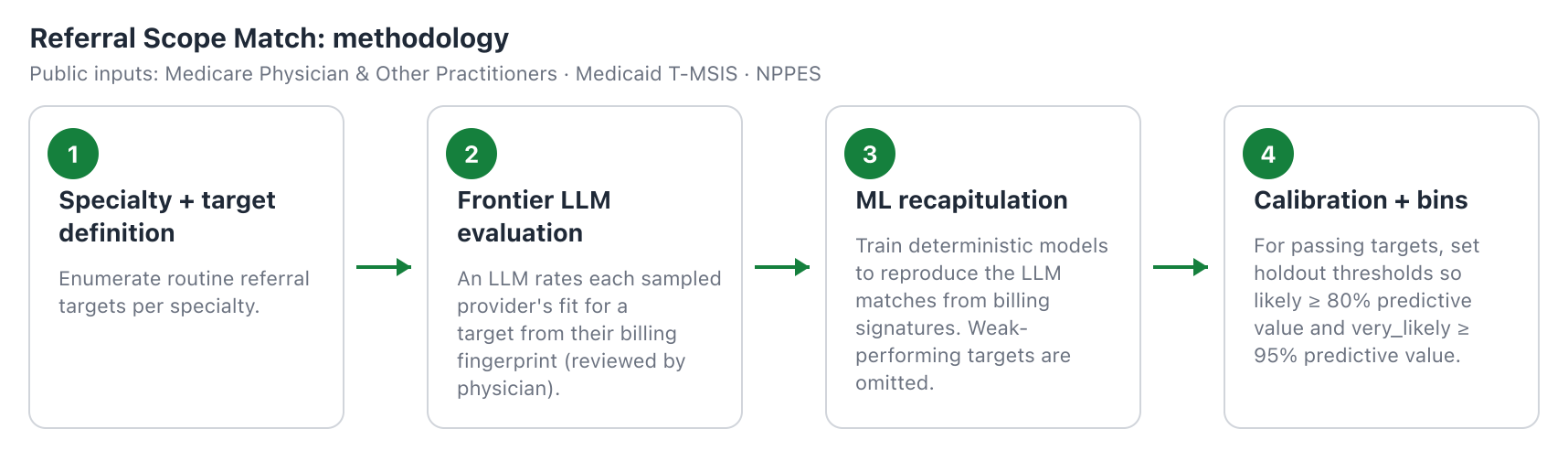
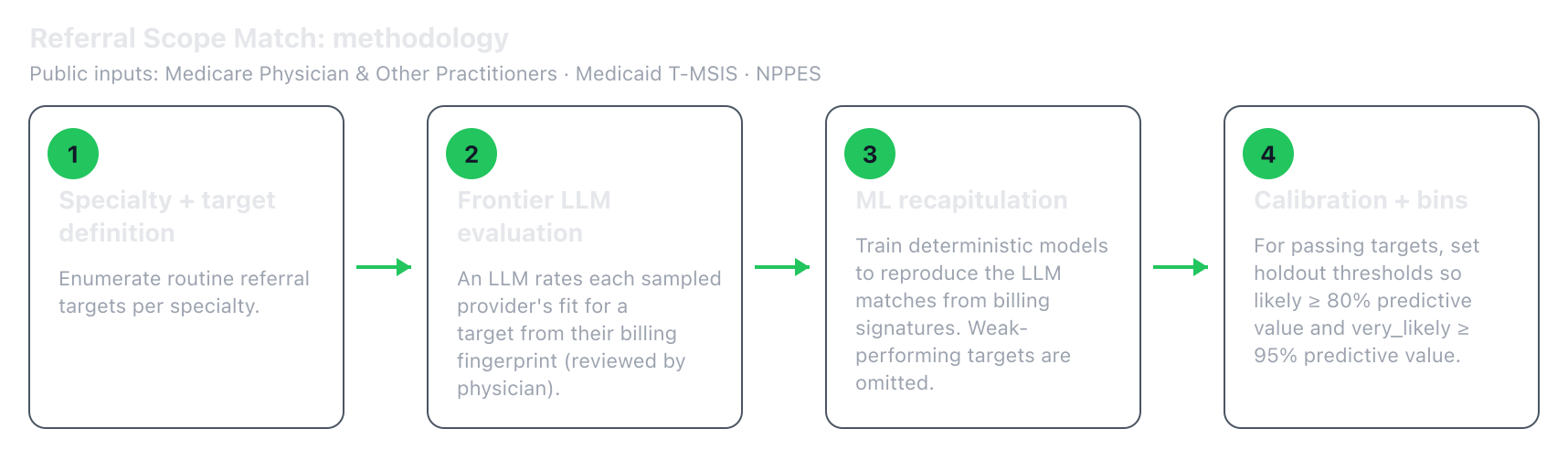
Figure 2: Diagram of the methodology.
Why we sometimes only rule targets out
Not every referral target can be answered in both directions. For many routine referral targets, billing data can confidently rule a provider out as a poor fit, but cannot reliably rule them in. When that is the case, we make it clear (therule_out_only field in the endpoint response).
Whether a target can be ruled in at all is determined empirically, from the data, not
decided by hand.
To understand why, consider the ongoing management of dementia. A memory-focused
practice does leave billing traces, like cognitive assessments and the medications
used to slow decline. But none of these belong to dementia care alone: general
neurologists, and often primary care physicians, bill the same assessments and
prescribe the same drugs. Because the codes recur so broadly, a heavy share of them
cannot separate the neurologists who concentrate on memory care from those who touch
it occasionally, so the evidence cannot rule in. The reverse is firmer: a neurologist
who bills none of this footprint can be confidently set aside, because a genuine
memory practice does not leave that whole footprint empty. The signal rules out, but
it cannot rule in, and no additional modeling recovers a positive trace that the
claims never recorded.


Figure 3: Each curve is colored by the label a provider at that operating threshold would receive. The left target shows a green (`likely_match`/`very_likely_match`) stretch up the left edge; the **rule-out-only** target has **no green at all**: its thresholds only ever reach `uncertain` or `unlikely_match`/`very_unlikely_match`, the visual signature of a target the data can rule out but cannot rule in.
How we calibrate
We set the thresholds so that, on a uniform sample drawn to represent the target specialty population, alikely_match call matches the LLM reasoning at
least 80% of the time and a very_likely_match call at least 95% of the time. The
rule-out thresholds are set the same way against the same bar, so an unlikely_match
or very_unlikely_match call carries the matching guarantee on the exclusion side.
Each label must clear its bar with a statistical lower bound, not just a point
estimate. That bound also prices in the measured run-to-run variability of the LLM
reasoning step: borderline judgments can flip on a re-run, and a label’s guarantee
has to survive that noise. A label that cannot hold its claim is folded into a
stricter neighbor or withheld rather than shipped.
When a target model does not reach a minimum performance or positive/negative
predictive performance, it is omitted and recorded as omitted, with the reason.
Ongoing validation
Predicting scope of practice from billing data isn’t new, but using it to judge routine referral fit is. We’re still learning where these predictions are strong and where they’re weak. We treat validation as ongoing rather than a one-time gate: as our reference data grows and as users surface corrections, we re-examine each target and revise or retire it when the evidence no longer backs the call. Three checks anchor this work. First, before a release, we re-test every shipped label against a fresh sample of providers that played no part in training or calibration. A label that fails this check is weakened or retired; it is never quietly kept. The same mechanism works in the other direction: a target that showed promise but had too few validation providers can earn its label through a dedicated, one-time confirmation sample. Second, we perform clinical-consistency reviews to ask whether a target’s predictions cohere with independent clinical expectations: do the specialists we rule in and rule out match how the specialty actually refers? We also inspect the clinical validity of the weights assigned to billing codes during machine learning. Third, when possible, we interrogate the observed-versus-expected (O/E) enrichment of providers’ self-attested subspecialties against our predictions when there is a strong match with a specific referral target.

Figure 4: When a referral target maps to a named subspecialty, our matching predictions are highly enriched for that specialty. Here, Retina specialists (a specialty taxonomy introduced in 2017) are over 4x enriched over expected. Yet more than half of the providers we strongly predict as appropriate for retina-focused referrals do not list this specialty on their NPI profile.
Other limitations
Some referral targets are billing-invisible. Some care is delivered almost entirely through office visits and routine lab work that carry no distinctive claims signature. Much of benign hematology looks this way: an anemia or iron-deficiency workup is evaluation and lab interpretation, and the providers who do it do not look different in claims from those who do not. We label such targets as omitted and make no predictions for them, rather than guess. Referral targets may change. Though we’ll do our best to keep the API stable, methodological improvements may mean we change target definitions where appropriate. Not all specialties are present. We focus on the most common specialties that patients are referred to in an ambulatory setting: ophthalmology, gastroenterology, cardiology, orthopedics, dermatology, otolaryngology, urology, neurology, and hematology-oncology. Let us know if there’s a specialty you’re eager to see included in the next release. Billing data is incomplete and dated. Predictions are based on billing from 2024, with the two prior years used to judge whether a provider is observed well enough to evaluate at all. The data reflects care provided to traditional Medicare and Medicaid patients, plus prescriptions filled under Medicare drug plans (including Medicare Advantage drug plans); medical claims under Medicare Advantage and commercial insurance are not visible. A provider may provide significantly different care to other populations, may have changed their scope of practice, or may provide services not reflected in billing data (for example, cash pay).What this model is not
This model reports a destination-fit signal. It is not a credentialing, licensure, or privileging source, and it does not assert what a provider is qualified or permitted to do. It reflects observed Medicare, Medicaid, and prescription billing, so a provider who practices primarily under commercial insurance, or who is newly in practice, may be observed too thinly to judge. That is precisely what theinsufficient_data label is
for. The referring clinician’s judgment remains the decision. Our aim is to make that
decision better informed at the moment it is made, not to replace it.